In the field of industrial safety and hazardous-area operations, explosion-proof amplified paging intercom stations play a critical role as both communication terminals and emergency safety devices. Among their core functions, audible and visual alarm systems have become indispensable for protecting personnel and significantly improving emergency response efficiency.
With the rapid advancement of coal mine automation and the Industrial Internet of Things (IIoT), alarm systems have evolved from simple signal indicators into comprehensive safety protection systems that integrate environmental monitoring, intelligent analysis, and multi-system coordination.
1. Technical Principles and Design Standards of Audible and Visual Alarm Systems
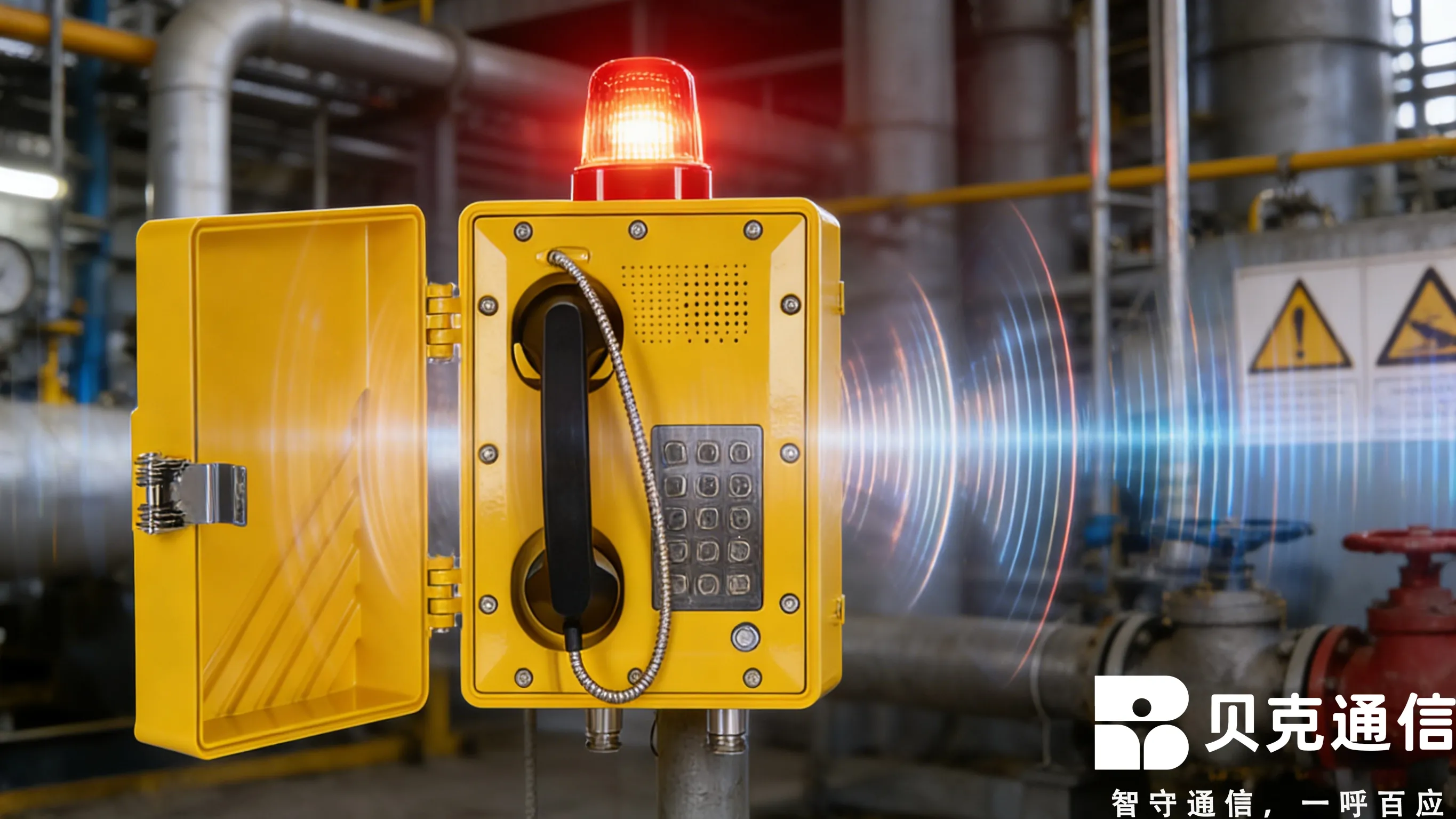
The audible and visual alarm systems used in explosion-proof paging intercom stations are based on intrinsically safe circuit design combined with flameproof enclosure protection technology. By strictly limiting electrical energy and adopting specialized sealing processes, these systems ensure safe operation in explosive atmospheres while delivering precise and reliable hazard warnings.
From a technical perspective, alarm system design follows GB 3836.4-2021, Explosive Atmospheres – Part 4: Equipment Protection by Intrinsic Safety “i”. This standard requires strict control of voltage, current, and stored energy within safe thresholds. For example, the minimum ignition energy of methane is approximately 0.2 mJ. Explosion-proof intercom circuits are designed so that even under fault conditions, the released energy remains below this threshold, effectively eliminating ignition risks caused by electrical sparks.
Key design standards include:
Sound pressure level ≥100 dB(A) at 3 meters, ensuring clear perception in underground coal mine environments where background noise can reach 120 dB
Flashing frequency of 60 flashes per minute (1 Hz), compliant with IEC 60079 visual warning requirements
Ingress protection rating of IP65/IP66, ensuring reliable operation in humid, dusty, and corrosive environments
System response time ≤15 seconds, covering the full process from hazard detection to alarm activation
Explosion-proof design adopts a three-layer protection architecture:
Flameproof enclosure (Ex d) using cast aluminum alloy or stainless steel, anti-static surface coating, joint gaps ≤0.15 mm, and pressure resistance ≥0.15 MPa
Intrinsically safe internal circuitry, utilizing potting and energy-limiting techniques to ensure energy levels remain below ignition thresholds
Epoxy-sealed sensors, preventing explosive gases from entering internal circuits while enhancing environmental protection
This design enables stable operation under extreme conditions ranging from -45°C to +70°C, 95% relative humidity, and high dust concentrations.
2. Performance and Advantages in Underground Coal Mine Applications
Underground coal mines represent a typical Class I explosive environment, where audible and visual alarm systems demonstrate exceptional safety value. According to National Mine Safety Administration data (2024), coal mine gas accident incidents and fatalities decreased by 44% year-on-year, with no fatalities caused by rock bursts or fires. Timely alarm systems played a key role in achieving these results.
Regulatory requirements specify that alarms must be installed in intake airways or chambers, at least 300 mm above the roadway floor. Visual signals must be clearly visible from 20 meters in darkness, while audible signals must reach ≥80 dB at 5 meters.
Modern explosion-proof paging intercom stations typically use:
Alarm systems are primarily used for:
When methane concentration reaches 0.5%–1.0% CH₄, alarms activate immediately. At ≥1.5% CH₄, the system not only triggers alarms but also automatically cuts off power to prevent ignition.
Practical results are significant. For example, the CTH1000 carbon monoxide alarm system reduced emergency response time from 15 minutes to 3 minutes, lowered false alarm rates below 2%, improved inspection efficiency by 200%, and reduced accident frequency to 0.03 incidents per million working hours.
3. Performance and Advantages in Petrochemical Applications
The petrochemical industry, representing Class II explosive environments, relies heavily on audible and visual alarm systems to protect tank farms, pipelines, and processing units.
According to GB/T 50493-2019, combustible gas detectors in tank farms must be spaced ≤10 meters, with alarms linked to form a closed-loop safety process covering detection, warning, and response.
Key technical requirements include:
IP66/IP67 protection for corrosive and salt-spray environments
Alarm sound level ≥100 dB(A)
Seamless integration with fire suppression, ventilation, and valve control systems
In real-world deployments, systems can automatically close valves or activate ventilation when gas concentrations exceed 10 ppm, while simultaneously transmitting location data to control centers.
Case studies show that facilities deploying over 300 explosion-proof alarm units achieved 99.8% system availability, successfully preventing major explosions and significantly reducing response times from hours to minutes.
4. Impact on Emergency Response Time
Audible and visual alarm systems dramatically shorten emergency response times by enabling sub-second triggering and multi-system linkage. From detection to alarm activation, the process can be completed in 0.3 seconds, far outperforming manual inspection methods.
In coal mines, gas over-limit alarm response rates reached 100%, while petrochemical leak response times were reduced from 2–4 hours to under 15 minutes, improving efficiency by more than 80%.
5. Impact on Evacuation Efficiency
High-intensity alarms (≥100 dB) and high-visibility flashing lights (visible ≥20 meters) penetrate dust, noise, and low-light conditions. Field data show that 95% of workers begin evacuation within 1 minute of alarm activation—over three times faster than traditional warning methods.
Advanced systems integrate GPS/BeiDou dual-mode positioning and indoor localization technologies, providing precise evacuation guidance and real-time situational awareness.
6. Impact on Rescue Success Rates
Rescue success rates increase significantly due to accurate information delivery and rapid system coordination. In coal mine rescue operations, alarm systems integrated with centralized safety platforms contributed to a 65% reduction in gas accidents compared with 2010 levels.
In petrochemical facilities, integration with automatic fire suppression and inert gas systems increased early-stage fire containment success rates from 60% to 98%.
7. Value and Limitations of Audible and Visual Alarm Systems
Key Value:
Early risk detection and extended response time
Multi-sensory warnings overcoming environmental interference
Automated response through IIoT integration
Limitations:
Performance degradation in extreme humidity or corrosive environments
High installation and maintenance requirements
Limited visibility in dense smoke without auxiliary technologies
8. Optimization Strategies and Future Trends
Future development focuses on:
Modular design and intelligent self-calibration
Multi-modal alarms (sound, light, vibration, tactile feedback)
AI-driven predictive analysis
Multi-parameter sensing (gas, temperature, dust, thermal imaging)
High-precision positioning (UWB, BeiDou/GPS)
Low-power wireless networking (LoRa, NB-IoT)
9. Practical Case Studies and Data Validation
Real-world deployments demonstrate fault rate reductions of over 75%, response time improvements of 80–95%, and significant reductions in accident frequency across both coal mining and petrochemical environments.
10. Conclusion
Audible and visual alarm functions in explosion-proof paging intercom stations have become a cornerstone of safety management in high-risk industries. By combining intrinsic safety design, flameproof protection, intelligent monitoring, and system integration, these solutions dramatically improve response times, evacuation efficiency, and rescue success rates.
As Industry 4.0 and IIoT technologies continue to evolve, alarm systems will shift from passive alerts to proactive, intelligent safety management platforms—serving as a critical foundation for safer, smarter industrial operations.

 English
 Deutsch
 한국어
한국어 Русский
 Français
 日本語
日本語 لالعربية
 हिन्दी
 Español
 Português
 繁体中文
繁体中文 简体中文
简体中文